

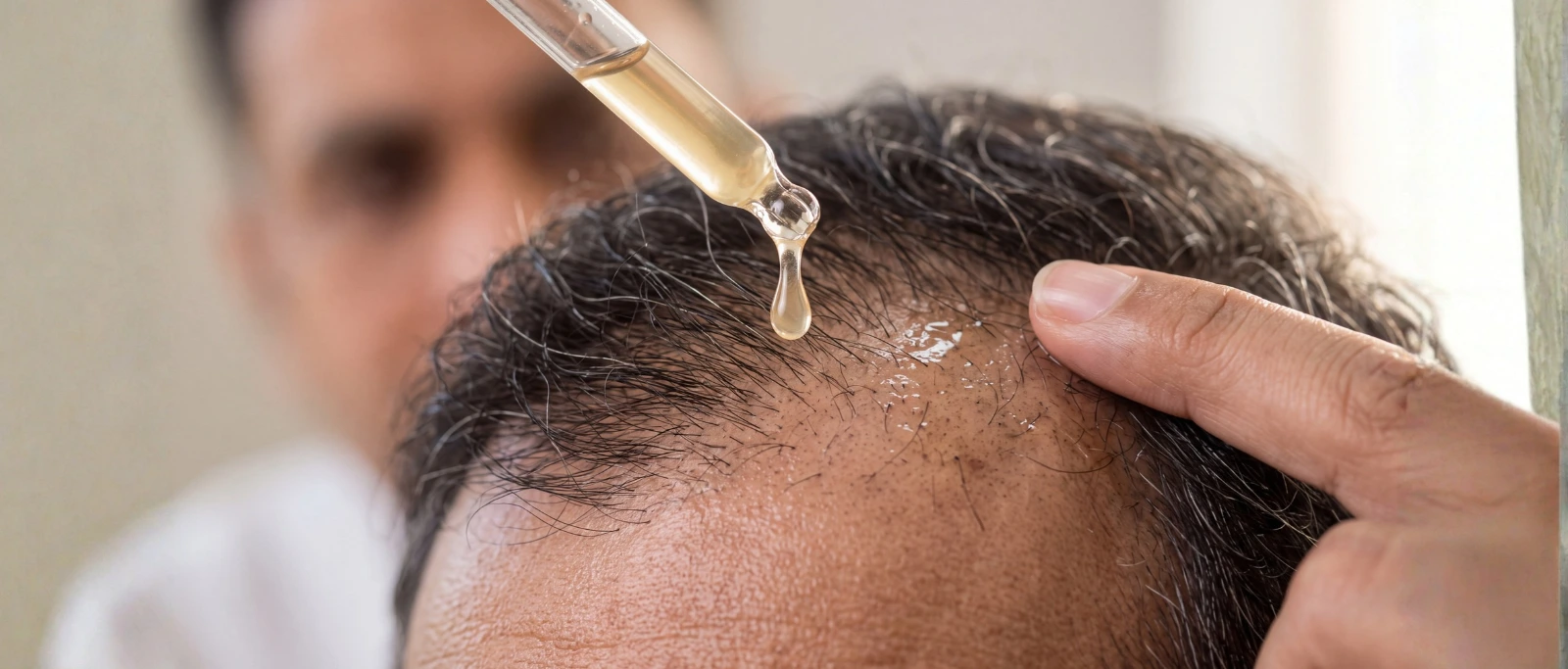
You have been putting minoxidil on your scalp every day for months. Maybe your hair looks better. But now you are tired. Your hair feels sticky, your scalp itches, the bottles keep costing money, and you keep hearing one scary line: “Once you start minoxidil, you can never stop.”
So what really happens if you stop? Will all your hair fall out? Will you become balder than before? Is there a safe way to quit?
This guide answers all of that in simple words, based on research and real clinic experience.
Quick Answer: What Happens When You Stop Minoxidil?
If you stop minoxidil, the extra hair it helped you grow usually falls out within 3 to 4 months. After that, your hair settles back to where it would have been if you had never used it.
- Stopping is not dangerous. There is no addiction and no withdrawal.
- Some people see a short phase where hair looks thinner than when they started, before it settles.
- If your hair loss was temporary (for example after fever, stress or delivery), you may keep your regrowth even after stopping.
- The safest way to stop is with a doctor’s plan, so another treatment protects your hair first.
How Minoxidil Works (In Simple Words)
Every hair on your head goes through a cycle. It grows, rests, falls out, and a new hair starts again.
In pattern hair loss (the kind that runs in families), the growing phase gets shorter and shorter. Hair comes back thinner and weaker each time, until the root almost stops making hair.
Minoxidil does two things:
- It keeps hair in the growing phase for longer.
- It improves blood flow to the hair roots.
But here is the important part: minoxidil does not fix the cause. The genes and hormones (mainly a hormone called DHT) that cause pattern hair loss are still there.
Think of it like a table fan keeping a balloon in the air. As long as the fan runs, the balloon floats. Switch the fan off, and the balloon slowly comes down. Minoxidil is the fan. The balloon is your hair.
What Happens When You Stop: Month-by-Month Timeline
| Time after stopping | What you may notice |
|---|---|
| First 4 weeks | Almost nothing. Hair looks the same. |
| Month 1 to 3 | Hair fall slowly increases. You see more hair in the comb and drain. |
| Month 3 to 4 | Most of the hair gained from minoxidil is lost. |
| Month 4 to 6 | Hair settles at the level it would have reached without minoxidil. |
| After 6 months | Hair loss continues at its natural speed, as if you never used it. |
Every person is different. Your timeline can be a little faster or slower.
What Does the Research Say?
- A 1987 study of 10 men with pattern baldness found that their hair counts roughly doubled while using minoxidil. When they stopped, they lost most of that new hair. In 4 of the 10 men, the hair count even dropped below where they started. This study was published in the Journal of the American Academy of Dermatology, and you can read it on PubMed here.
- A larger 1999 study stopped minoxidil after nearly two years of use. Hair weight and hair count dropped quickly, briefly went below the starting level, and then came back close to the starting level about three months later.
What this means for you: You will not end up permanently balder because you used minoxidil. You simply lose the extra help it was giving. The short dip below your starting point is temporary.
Myths vs Facts
| Myth | Fact |
|---|---|
| “Once you start, you’re addicted.” | Minoxidil is not addictive. Your body does not become dependent on it. You only lose the extra hair it was supporting. |
| “Stopping makes you balder than before.” | You may see a short dip, but hair settles back to your natural level. |
| “Missing a day ruins everything.” | Missing a dose now and then does not undo months of progress. Just continue with the next dose. Never double up. |
| “Minoxidil causes hair loss.” | Some extra shedding in the first few weeks of starting is common. This is weak hair making way for stronger hair. |
| “It works on every type of hair loss.” | It works best for pattern hair loss and thinning areas. It cannot regrow hair on fully bald, shiny skin. |
Your Worries, Answered
“I can’t apply it every day for the rest of my life.”
That is a fair feeling. Talk to a dermatologist about other options. Many people use clinic treatments or doctor-prescribed medicines so they can depend less on daily application.
“My scalp itches, flakes or burns.”
Scalp irritation is one of the most common reasons people quit. The foam version is often gentler than the liquid. Do not just stop and suffer. Get your scalp checked, because dandruff or allergy may be the real cause.
“I’m a woman and I’m getting extra facial hair.”
This can happen, especially with stronger versions. It usually settles after stopping or switching. A doctor can adjust your treatment.
“I’ve used it for 2 months and see nothing.”
Minoxidil usually takes 2 to 4 months to show results. If there is still no new hair after about 4 months of regular use, stop and see a doctor instead of continuing blindly.
“I’m pregnant or planning a baby.”
Tell your doctor right away. Minoxidil is generally not used during pregnancy or breastfeeding.
“It’s too expensive every month.”
Compare the yearly cost of minoxidil with a planned clinic treatment. Sometimes a short course of in-clinic treatment plus a cheaper maintenance plan works out better.
Who Can Stop Minoxidil With Less Risk?
- People with temporary hair fall. If hair fell after fever, illness, crash dieting, stress or delivery, and that cause is over, your new hair often stays even after stopping.
- People who have a backup plan. If another treatment is already protecting your hair (for example, a doctor-prescribed medicine or regular clinic sessions), stopping minoxidil may cause little loss.
- People whose root cause was treated. For example, women whose thyroid or hormone problem is now under control.
Who Should Think Twice Before Stopping?
- People with moderate to advanced pattern hair loss and no other treatment in place
- People who have seen great results and would be upset to lose them
- People using oral minoxidil tablets. Never start or stop tablets on your own. Your doctor must guide this.
How to Stop Minoxidil the Smart Way
- See a dermatologist first. Find out what type of hair loss you have. The plan for genetic thinning is very different from temporary shedding.
- Start your backup treatment before you stop. Let the new treatment start working while you are still on minoxidil. This overlap protects your hair.
- Don’t stop suddenly. Your doctor may slowly reduce how often you apply it instead of stopping overnight. Sudden stopping usually means sudden shedding.
- Take monthly photos. Same room, same light, same angle. Photos show real change better than the mirror.
- Review at 3 and 6 months. If you are losing too much, you and your doctor can adjust the plan early.
Stopping Suddenly vs Stopping With a Plan
| Point | Stopping suddenly | Stopping with a doctor’s plan |
|---|---|---|
| Hair fall | Comes faster and heavier | Usually slower and milder |
| Hair protection | None | Backup treatment already working |
| Stress level | High (you panic at the drain) | Lower (you know what to expect) |
| Chance of keeping results | Low for genetic hair loss | Much better |
Treatments That Can Support or Replace Minoxidil
The right option depends on your type of hair loss. A dermatologist may suggest:
- Doctor-prescribed medicines that work on the hormone behind pattern hair loss. These need a prescription and regular follow-up.
- Hormone treatment for women, for example when PCOS or thyroid problems are behind the hair fall.
- PRP or GFC therapy, which use growth factors from your own blood to support weak roots.
- Hair mesotherapy, which delivers nutrients into the scalp.
- Microneedling, which can help the scalp respond better to treatment. Read more about using a derma roller for hair growth.
- Fixing the basics: iron, vitamin D, thyroid levels, protein in your diet and stress. Our guide on the best ways to stop hair loss covers these daily habits.
- Hair transplant, for fully bald areas where roots are already gone.
When to See a Doctor Right Away
Stop using minoxidil and see a doctor if you notice:
- Chest pain, a fast or pounding heartbeat, fainting or dizziness
- Swelling of the hands or feet, or sudden weight gain
- Severe scalp redness, burning, crusting or a rash
Also get checked if your hair suddenly starts falling in large amounts, you see round bald patches, or your scalp is painful.
Final Verdict
Stopping minoxidil is safe, but it is not free. If your hair loss is genetic, the hair minoxidil was holding up will usually fall within 3 to 4 months, and your hair will go back to its natural course.
The good news? You don’t have to choose between “minoxidil forever” and “lose everything.” With the right plan, many people move to treatments that suit their lifestyle better and still protect their hair.
Get a Hair Plan That Fits Your Life at Adore, Andheri
At Adore Skin, Hair & Laser Clinic in Andheri, Mumbai, Dr. Madhavi Valvi and her team check your scalp, find the real reason behind your hair fall, and help you decide whether to continue minoxidil, reduce it, or switch to something else.
Explore our hair loss treatment or our hair thinning treatment, or book a consultation to make a plan before you stop.
Frequently Asked Questions
A break of a few days usually does not undo your progress. A break of several weeks or more can start the shedding process, so plan longer breaks with your doctor.
For most people, yes. But regrowth takes a few months again, and you may see some shedding in the first few weeks after restarting.
Yes. Many people with an itchy or sensitive scalp find the foam more comfortable. Ask your doctor which strength is right for you.
Some people notice small changes in hair colour or texture while using it. This is usually harmless, but mention it to your doctor.
Apply minoxidil on a dry scalp and let it absorb first. Use oil or other products later, so they do not dilute or block it.
Usually yes. Skip minoxidil on the day you colour your hair, and wait until your scalp is calm before restarting.
Topical minoxidil is not approved for children. Teenagers with hair loss should see a dermatologist first, as the cause is often different.
Not always. Some products are made for women, and stronger versions may cause more facial hair. Let a doctor choose the right product, and never share yours.
Yes, it can be dangerous for pets, especially cats. Let it dry fully, wash your hands, don't let pets lick your scalp or pillow, and store the bottle out of their reach.
Give it a few hours to absorb. Applying it just before the gym, a swim or a head wash means much of it gets washed away.
Many surgeons use it to support existing hair after a transplant. Follow your surgeon's advice on when to start and stop.
It works best on the crown and thinning areas. Results at the temples and front hairline are often weaker, so your doctor may suggest other options for that area.