

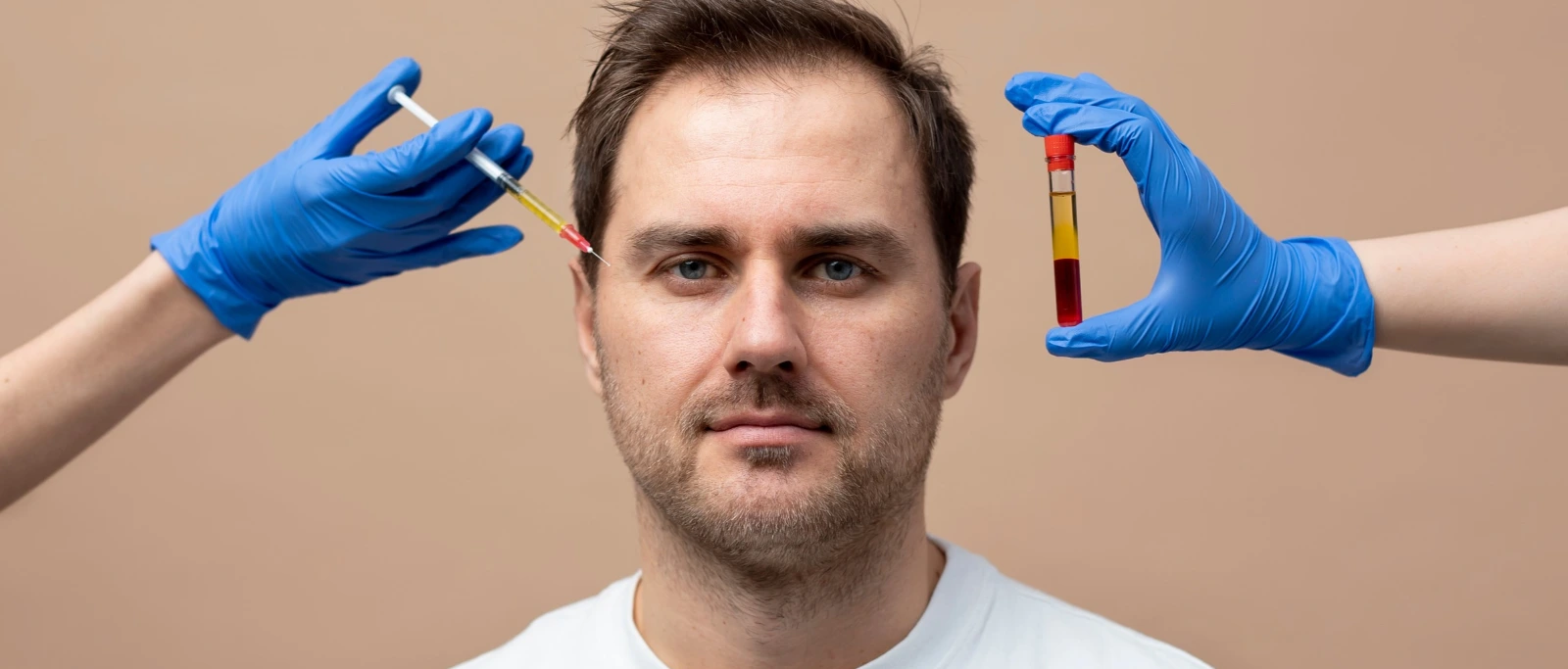
You see more hair on your pillow every morning. Your parting looks wider in photos. One clinic tells you to get PRP. Another says GFC is “the latest and best.” Now you are confused, and nobody has explained the difference in plain words.
This guide does exactly that. By the end, you will know what PRP and GFC are, how they differ, what the research really says, what they cost in Mumbai, and which one makes sense for you.
Quick Answer: PRP or GFC?
GFC usually shows results faster and feels more comfortable. PRP costs less per session and has more research behind it. Both use your own blood, and both work best when your hair is thinning, not fully gone.
- Pick GFC if you want quicker visible change, have a sensitive scalp, or PRP did not help you enough.
- Pick PRP if your thinning is in the early stage and you want a lower cost per session.
- Many doctors now combine both: GFC for a fast start, PRP for steady maintenance.
What Is PRP Hair Treatment?
PRP stands for Platelet-Rich Plasma. Platelets are tiny cells in your blood that help heal wounds.
Here is how it works:
- The doctor takes a small amount of blood from your arm, like a normal blood test.
- The blood is spun in a machine called a centrifuge. This collects the platelets in one layer.
- This platelet-rich layer is injected into the thin areas of your scalp.
Once inside the scalp, the platelets slowly release growth factors. These are natural proteins that tell weak hair roots to wake up, grow stronger, and stay in the growing phase longer.
PRP has been used for hair loss for more than ten years, so doctors have a lot of experience and research to rely on.
What Is GFC Hair Treatment?
GFC stands for Growth Factor Concentrate. It starts the same way as PRP, with a small blood draw.
The difference is in the processing. Your blood goes into special tubes that activate the platelets inside the tube itself. So the growth factors are released before the injection, not after. The doctor then injects only the clear growth-factor liquid. There are no platelets, no red blood cells and no white blood cells in it.
The Real Difference, Explained Simply
Think of making tea.
- PRP is like putting tea leaves in your cup and waiting for them to brew. The “brewing” (release of growth factors) happens inside your scalp over a few days.
- GFC is like being served tea that is already brewed and strained. The brewing already happened in the tube. You get only the useful part.
Because PRP brews inside your scalp, it can cause more soreness, redness and swelling. GFC is cleaner, so most people find it gentler.
PRP vs GFC: Side-by-Side Comparison
| Point | PRP | GFC |
|---|---|---|
| What is injected | Platelets in plasma | Only growth factors (no blood cells) |
| Blood drawn | Small amount, like a blood test | Small amount, like a blood test |
| Pain during injection | Mild to moderate | Mild |
| Redness or swelling after | Common, settles in 1–2 days | Less, usually settles within a day |
| Sessions usually needed | 4–6 | 3–4 |
| Gap between sessions | 3–4 weeks | 3–4 weeks |
| Less hair fall noticed in | About 6–8 weeks | About 3–4 weeks |
| Visible thickness in | About 3–6 months | About 2–4 months |
| Cost per session in Mumbai | ₹3,000 – ₹8,000 | ₹7,000 – ₹15,000 |
| Research behind it | More studies, longer track record | Newer, early studies look promising |
| Best for | Early thinning, budget start, maintenance | Faster results, sensitive scalp, PRP non-responders |
Timelines and prices vary from person to person and clinic to clinic.
What Does the Research Actually Say?
Many blogs simply say “GFC is better.” The real picture is more balanced, and you deserve to know it.
- GFC works faster, PRP may last longer. A 2025 study in the journal Dermatologic Surgery compared PRP and GFC in 42 men and women with pattern hair loss, with three sessions each. GFC improved hair count and hair thickness faster, often after the second session. PRP caused more redness. But at the 6-month check, the PRP group had better hair thickness and better overall appearance scores. The researchers suggested using the two treatments one after the other for lasting results.
- GFC looks safe and promising in early studies. A small case series published on the NIH’s PubMed Central reported faster hair growth, better hair quality and very few side effects with GFC in three to four sittings.
- More Indian data is coming. In 2025, a randomized trial comparing PRP and GFC was registered in India because comparison data for Indian patients is still limited.
What this means for you: GFC gives a quicker start. PRP gives steady support. Neither is a magic shot. Be careful of any clinic that promises “guaranteed regrowth.”
Your Worries, Answered
“I’m scared of injections.”
A numbing cream is applied first, and very fine needles are used. Most people describe it as small pinches or pressure, not real pain. If pain worries you a lot, GFC is usually the gentler choice.
“My budget is tight.”
PRP costs less per session, so it is a fair place to start. Just do the full-course math (see the cost section below) before you decide.
“I already tried PRP and saw little change.”
Doctors often suggest GFC for this exact situation. But first check two things: did you finish all the sessions, and was the root cause of your hair fall (like thyroid, low iron or stress) treated? If not, any treatment will struggle.
“I have a wedding in two or three months.”
GFC tends to show early improvement faster, so it suits a time limit better. Start at least three months before the event. No treatment can give you a full head of hair in a few weeks.
“I’m a woman with thinning after pregnancy or hormone changes.”
Both PRP and GFC work for women. Hair fall after delivery often settles on its own within months, so your doctor will first check whether you need treatment at all.
“My crown is completely bald and shiny.”
Neither PRP nor GFC can grow hair where the roots are already gone. They work on weak roots, not dead ones. For fully bald areas, a hair transplant is the option to discuss.
“I’m already using minoxidil or tablets.”
That is fine. PRP and GFC work alongside your doctor-prescribed medicines. They do not replace them.
Which One Should You Choose? A Simple Decision Guide
Choose PRP if:
- Your hair fall or thinning has just started
- You want a lower cost per session
- You prefer the treatment with the longest track record
- You need maintenance sessions after finishing a course
Choose GFC if:
- You want visible change sooner
- You have low pain tolerance or a sensitive scalp
- PRP did not give you enough results earlier
- You want fewer clinic visits
Consider combining both if:
- Your thinning is moderate
- You want a fast start with GFC, followed by PRP to keep results going
Neither is right (yet) if:
- The area is completely bald
- You suddenly started losing a lot of hair and have not had a check-up
- You have round, patchy bald spots. This may be alopecia areata and needs a proper diagnosis first.
PRP vs GFC Cost in Mumbai: The Full-Course Math
The per-session price is only half the story. What matters is the cost of the full course.
| Treatment | Sessions | Price per session | Full course (approx.) |
|---|---|---|---|
| PRP | 4–6 | ₹3,000 – ₹8,000 | ₹12,000 – ₹48,000 |
| GFC | 3–4 | ₹7,000 – ₹15,000 | ₹21,000 – ₹60,000 |
So even with fewer sessions, GFC usually costs a bit more overall. In return, you get a gentler experience and faster early results.
The price can change based on:
- The brand of kit used
- The doctor’s experience
- The size of the area being treated
- Add-ons like microneedling
- Package pricing and maintenance sessions
Always ask for the full-course cost, not just the first session price.
What Happens During a Session at Adore?
- Consultation and scalp check. The doctor looks at your scalp closely, often with a trichoscope, to see how many roots are still active.
- Numbing. A numbing cream is applied to the treatment area.
- Blood draw. A small amount of blood is taken from your arm.
- Processing. For PRP, the blood is spun in a centrifuge. For GFC, it goes into special activation tubes.
- Injection. The prepared solution is injected into thinning areas with fine needles.
- Done. The whole process takes about 45 to 60 minutes, and you go home the same day.
Aftercare: The First 48 Hours
- Do not wash your hair for 6 to 8 hours.
- Avoid direct sun, the gym and heavy sweating for 24 to 48 hours.
- Skip harsh hair products and styling for a few days.
- Cut down on smoking and alcohol, as they slow healing.
- Do not scratch or rub the treated area.
Why Some People Don’t See Results (and How to Avoid It)
- Stopping too early. Hair fall reduces after one or two sessions, so people stop. The roots need the full course to get stronger.
- Ignoring the root cause. Thyroid problems, low iron, low vitamin D, stress and crash diets can all keep hair falling. These need fixing too. Our hair loss treatment tips cover the daily habits that help.
- Wrong candidate. If the roots are already gone, injections cannot bring them back.
- No maintenance. Pattern hair loss keeps progressing. Most people need a top-up session every 6 to 12 months.
- Poor technique or kit. Results depend a lot on who does it and how.
Who Should Avoid It or Wait?
Tell your doctor before treatment if you:
- Have a blood or platelet disorder
- Take blood-thinning medicines
- Have an active scalp infection or open wound
- Are under treatment for cancer or another serious illness
Your doctor will decide if it is safe for you or if you should wait.
Can PRP or GFC Be Combined With Other Treatments?
Yes, and that often gives the best results. Doctors commonly pair them with:
- Doctor-prescribed hair loss medicines
- Microneedling, which can help the scalp respond better. Read more about using a derma roller for hair growth.
- Hair mesotherapy
- Hair transplant, to support healing and new growth
Final Verdict
There is no single “winner” for everyone.
- GFC is the better choice when you want faster results and more comfort, and you are fine paying a bit more.
- PRP is the better choice when your thinning is early, your budget is tighter, or you need ongoing maintenance.
- For many people, using both gives the best of both worlds.
The right answer depends on your stage of hair loss, your scalp, your budget and your timeline. A proper scalp check is the only way to know for sure.
Get the Right Plan at Adore, Andheri
At Adore Skin, Hair & Laser Clinic in Andheri, Mumbai, Dr. Madhavi Valvi and her team check your scalp first and then suggest what will actually work for you, not what is trending.
Explore our hair PRP treatment or our GFC therapy, or book a consultation to find out which one suits your hair.
Frequently Asked Questions
Yes. Many patients switch if their response to PRP is slow. Your doctor will plan the switch so the gap between sessions stays right.
It is best to wait about a week. Chemicals can irritate the freshly treated scalp. Ask your doctor for the exact gap based on the product you plan to use.
Yes. There is no real downtime. Some people have mild redness for a few hours, which is usually hidden by hair.
A few people notice slightly more shedding in the first few weeks. This is usually old, weak hair making way for new growth and settles on its own. Tell your doctor if it worries you.
Yes, in most cases. Some women feel the scalp is a little more sensitive during periods, so you can shift the date if you prefer.
Most doctors postpone these treatments during pregnancy. If you are breastfeeding, discuss it with your doctor first.
It is usually done for adults aged 18 and above. Teenagers with hair loss need a proper check-up first, as the cause is often different.
Some doctors use it for patchy beards and thin eyebrows. The research is smaller than for scalp hair, so discuss realistic results with your doctor.
A loose, clean cap is fine. Try to avoid a tight helmet for about 24 hours, as pressure and sweat can irritate the scalp.
Avoid swimming pools for at least 48 hours. Chlorine can irritate the injection points and raise the risk of infection.
Mild dandruff is usually not a problem. But if your scalp is red, inflamed or infected, the doctor will treat that first.
Not because of gender. The number of sessions depends on how advanced the thinning is and how your scalp responds.