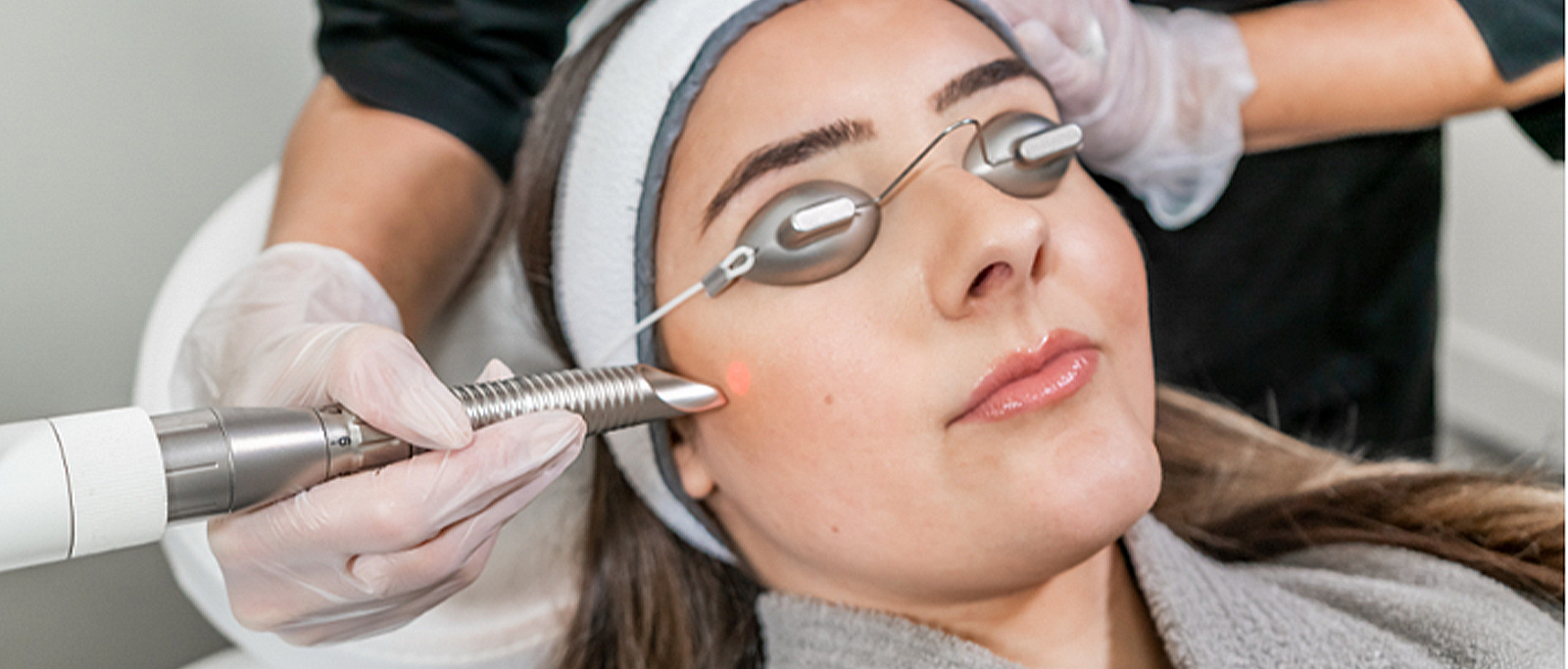
The Q switched laser is used to remove unwanted brown spots from the skin. It is a non-invasive laser. The laser emits energy or heat pulse which releases the pigment into the skin so it can be naturally reabsorbed and disposed of by the body. The energy emitted from the Q switched laser is concentrated into very powerful pulses. The laser feels like tiny dots on the skin. You may feel little discomfort during the treatment. We try our best to minimize the slight discomfort by the steam of cold air during the treatment.
It takes care of any intense color like black or deep brown in pigment on the skin, hair, or colors in a tattoo. Depending on the wavelength it
penetrates to different depths of the skin. The pigment absorbs the laser energy and gets fragmented within the skin’s tissues, thereby giving you a smooth and even skin tone.
Q switched lasers have made a huge impact in the aesthetic world, primarily for their ability to safely and effectively remove unwanted tattoos. However, that’s not all they’re capable of doing. This innovative technology has been instrumental in the development of various clinical and dermatological applications.
Two elements make Q-Switched Nd-YAG lasers essential for treating skin conditions:
- The 1064 nm and 532 nm wavelengths can be useful for targeting certain pigments.
- The pulse is powerful enough to destroy its target but brief enough to not harm the skin
There are two main types of Q switching:
- Active Q switching: This may be a mechanical device such as a shutter, or a chopper wheel. The reduction of losses (an increase of Q) is triggered by an external event, typically an electrical signal. The pulse repetition rate can, therefore, be externally controlled. Modulators generally allow a faster transition from low to high Q and provide better control. An additional advantage of modulators is that the rejected light may be coupled out of the cavity and can be used for something else.
- Passive Q switching: In this case, the Q-switch is a material whose transmission increases when the intensity of light exceeds some threshold. As the laser power increases, it saturates the absorber, i.e., rapidly reduces the resonator loss, so that the power can increase even faster. Ideally, this brings the absorber into a state with low losses to allow efficient extraction of the stored energy by the laser pulse. After the pulse, the absorber recovers to its high-loss state before the gain recovers, so that the next pulse is delayed until the energy in the gain medium is fully replenished.
Q switched laser is used for:
- Even skin tone
- Acne
- Mole
- Sunspot
- Dark circles
- Enlarged pores
- Unwanted tattoos
- Pigmented lesions (brown spots, age spots, etc)
- Toenail fungus
- Skin rejuvenation
- Non-ablative skin rejuvenation
In all these above cases, the Q switched laser is important for the treatment because the laser can penetrate the skin or the nail without any harm. The energy is absorbed by the targeted area (whether it be tattoo pigmented, hemoglobin, melanin, or fungus).
Two different wavelengths are used for different applications as per the requirement, as they are absorbed differently by the pigments and chromophores.
FAQs for Q-Switched Nd:Yag Laser Treatment in Andheri, Mumbai
Q-Switched Nd:YAG Laser is an advanced laser therapy that emits high-intensity light pulses in ultra-short nanoseconds to break down pigmentation, tattoo ink, and melanin deposits in the skin without damaging surrounding tissue. The body then naturally eliminates the fragmented particles, resulting in clearer, even-toned skin.
Q-Switched Nd:YAG Laser effectively treats a wide range of skin concerns including melasma, freckles, sunspots, age spots, pigmentation, tattoo removal, carbon laser facial, acne scars, dark circles, uneven skin tone, and skin rejuvenation. It works on both superficial and deeper skin layers depending on the wavelength used.
Yes, Q-Switched Nd:YAG Laser is considered one of the safest laser treatments for darker Indian skin tones. It uses a 1064 nm wavelength that bypasses the surface melanin and targets deeper pigmentation, significantly reducing the risk of post-inflammatory hyperpigmentation commonly seen with other laser types.
The number of sessions depends on the skin condition being treated. For pigmentation and skin brightening, 4 to 6 sessions are typically recommended. Tattoo removal may require 6 to 12 or more sessions depending on ink color, depth, and size. Your dermatologist will create a customized treatment plan based on your specific concern.
Most patients describe the sensation as a mild snapping or tingling feeling, similar to a rubber band flicking on the skin. The procedure is generally well tolerated with minimal discomfort. A topical numbing cream is applied before the session to ensure maximum comfort, making it a virtually pain-free experience for most patients.
Unlike ablative lasers that remove the outer skin layer, Q-Switched Nd:YAG Laser is a non-ablative treatment that works beneath the skin surface without causing visible damage. It offers more precision, faster recovery, and is suitable for a broader range of skin tones compared to fractional CO2 or Erbium lasers, making it a preferred choice globally.
A Carbon Laser Facial, also called the Hollywood Peel or China Doll Facial, uses the Q-Switched Nd:YAG Laser in combination with a carbon lotion applied to the face. The laser targets and vaporizes the carbon particles along with dead skin cells, excess oil, and blackheads, leaving the skin deeply cleansed, bright, smooth, and rejuvenated in a single session.
A typical Q-Switched Nd:YAG Laser session lasts between 20 to 45 minutes depending on the area being treated and the condition addressed. Carbon laser facials are usually completed within 30 minutes, while tattoo removal sessions on larger areas may take slightly longer. There is no downtime, so patients can resume normal activities immediately.
Q-Switched Nd:YAG Laser is well-tolerated with minimal side effects. Some patients may experience mild redness, temporary swelling, or slight darkening of the treated area immediately after the session, which typically resolves within 24 to 48 hours. Serious complications are rare when the procedure is performed by a trained and certified dermatologist.
Before your session, avoid sun exposure for at least two weeks and stop using retinoids, AHAs, BHAs, or any active skincare ingredients 5 to 7 days prior. Do not wax or use hair removal creams on the treatment area. Come with clean, makeup-free skin and inform your dermatologist about any ongoing medications or recent skin treatments.
Post-treatment care includes applying a gentle moisturizer and broad-spectrum SPF 50 sunscreen daily. Avoid direct sun exposure, swimming, steam rooms, and harsh skincare products for at least one week. Do not pick or scrub the treated area. Follow your dermatologist's prescribed skincare routine to enhance results and minimize any risk of pigmentation recurrence.
Results from Q-Switched Nd:YAG Laser can be long-lasting, especially when combined with proper sun protection and a consistent skincare routine. Pigmentation treatment results can last months to years, while tattoo removal results are typically permanent. Maintenance sessions every 3 to 6 months may be recommended for sustained skin brightening and anti-aging benefits.
Yes, Q-Switched Nd:YAG Laser can be safely combined with other treatments such as chemical peels, microneedling, PRP therapy, hydrafacials, and dermal fillers for enhanced results. Your dermatologist will recommend the best combination protocol based on your skin goals, ensuring each treatment complements the other for maximum efficacy and safety.
Ideal candidates include individuals dealing with pigmentation, melasma, uneven skin tone, acne scars, fine lines, open pores, dull skin, or unwanted tattoos. It is suitable for all skin types including dark skin tones. However, it is not recommended for pregnant or breastfeeding women, individuals on photosensitizing medications, or those with active skin infections in the treatment area.
The cost of Q-Switched Nd:YAG Laser treatment in India varies based on the condition being treated, the number of sessions required, the size of the treatment area, and the clinic's expertise and location. On average, a single session can range from Rs. 1,500 to Rs. 8,000. A detailed cost estimate is provided during the initial consultation after a thorough skin analysis.